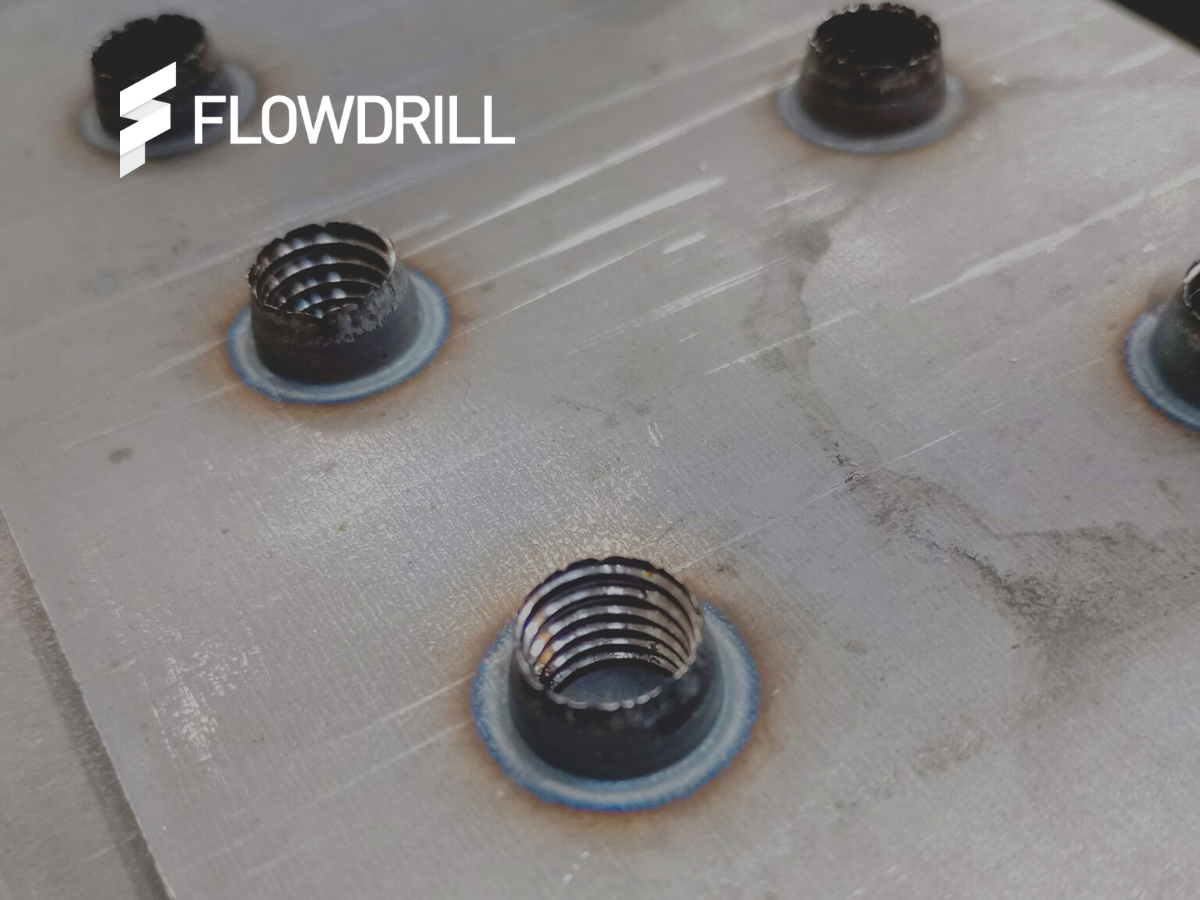
High-strength steel (e.g. 16MnCr5, 25CrMo4): Can be suitable with adapted process parameters. Some extreme types are not suitable. We’re happy to help you explore the possibilities.
Friction drilling relies on material ductility and thermal conductivity. This page explains which materials are suitable and under which conditions they perform optimally.
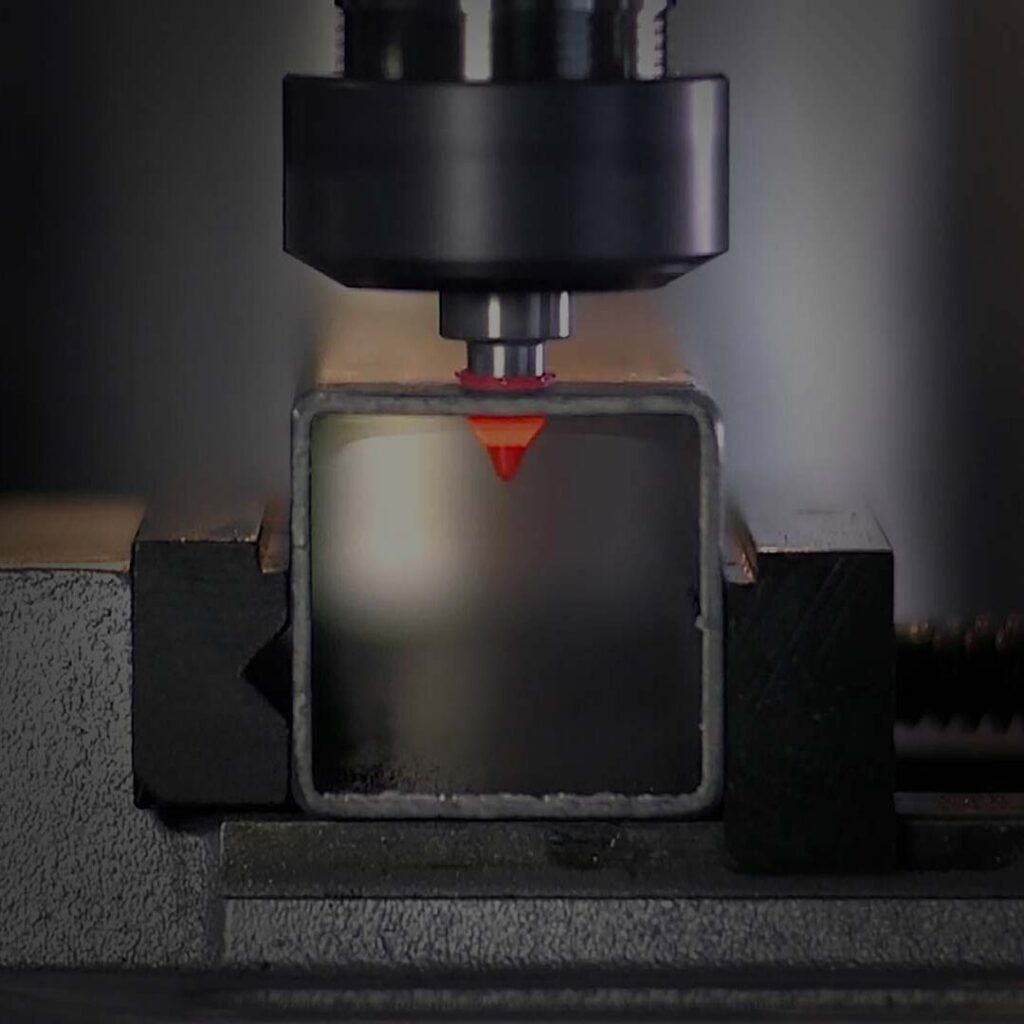
To understand which materials are suitable, it’s important to first understand how friction drilling works. Friction drilling is a process where a specially designed drill bit uses heat and pressure to plastically deform the metal.
The material is displaced upward and downward, forming a strong collar and sleeve.
This allows you to create threaded holes in thin metal sheets or tubes without needing additional fasteners such as nuts or inserts.
Friction drilling works excellently on metals that are ductile and have a lower melting point. The main suitable materials are:
Mild steel (S235): Commonly used in various applications. Frictiondrilling in S235 is no problem at all.
Stainless steel (304/316): Requires adjusted drilling parameters due to higher strength and heat generation. Local discoloration from heat is possible but can be treated with passivation techniques.
Aluminium 6060-T6 and other aluminium alloys: All types of aluminium are suitable for frictiondrilling. This is due to the low melting and deformation temperature.
Note: we do recommend using our specially developed Aludrill.
Copper and brass (CuZn39Pb3, CW614N): Is suitable for friction drilling, but requires adjusted parameters. Please contact us, we are happy to help you!
Some materials or areas on profiles are less or not suitable for friction drilling due to their thermal or mechanical properties. However, there is sometimes a possibility or a workaround.
Hardened steel (e.g. hardened 16MnCr5, hardened C45M): The material is too hard and causes excessive tool wear. Not suitable without special pre-processing. Contact us to discuss the possibilities.
Some coatings and protective layers may be damaged during friction drilling.
Galvanized steel
Powder coating and ED coating
Our engineers are here to help.
Send us a message