Designing for recyclability is becoming a core requirement in industries such as automotive, furniture, machinery and consumer products. Friction drilling contributes to higher material purity and more efficient end-of-life processing because the joint adds no foreign materials to the structure. This page explains why Flowdrill joints outperform traditional fastening methods when it comes to recycling and circular material flows.


A friction-drilled joint forms a bush by displacing and elongating the existing parent material. No nuts, bolts, weld nuts, rivets or inserts are required. The assembly remains a single-material component, which provides three direct recycling advantages:
Conventional fasteners introduce extra alloys such as zinc-plated steel, stainless steel, brass or aluminum inserts. These contaminate the material stream during shredding and separation.
A Flowdrill joint avoids this by using only the base material to create the functional thread.
The result: a cleaner metallurgical profile during end-of-life processing.
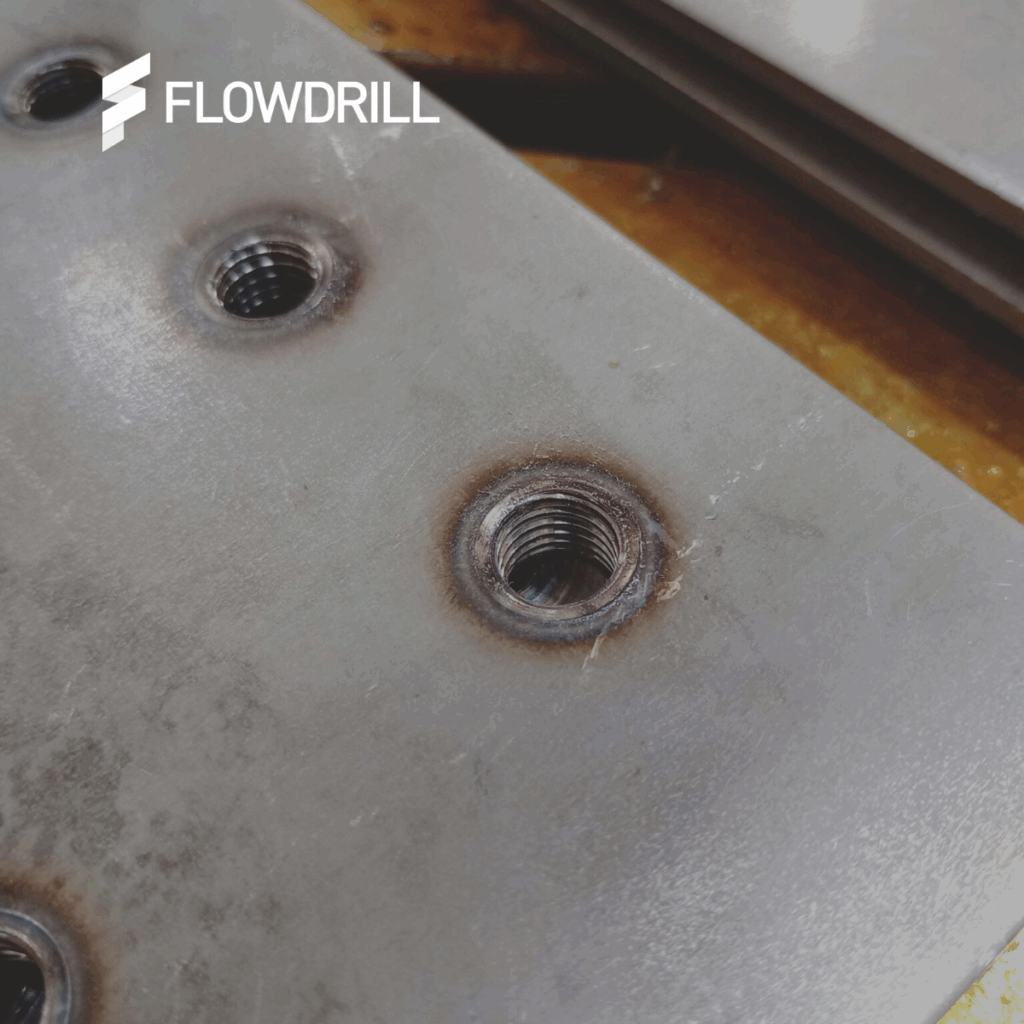

Mixed-metal joints reduce recycling efficiency because separation requires extra sorting, magnetics or density-based processes. Friction drilling eliminates this complexity.
This increases the value of the material and improves processing consistency for smelters and recyclers.
Traditional connections require removing multiple parts: nut, washer, insert. Each component introduces sorting complexity and risk of misclassification during waste processing.
This increases the value of the material and improves processing consistency for smelters and recyclers.

Traditional connections require removing multiple parts: nut, washer, insert. Each component introduces sorting complexity and risk of misclassification during waste processing.
A Flowdrill joint is a single-piece connection.
This supports modern circular-design requirements such as ISO 20887 and EU-level sustainability directives for automotive and electronics.
Because friction drilling avoids additional materials, products:
This enables manufacturers to meet stricter sustainability and recyclability KPIs without compromising mechanical performance.